

The Comfort Fit (CF) hearing aid combines the natural feel of an open-fit design with advanced hearing technology. Its slim profile sits comfortably behind the ear while allowing natural sound to enter the ear canal, making it an excellent choice for many people with mild to moderate hearing loss.
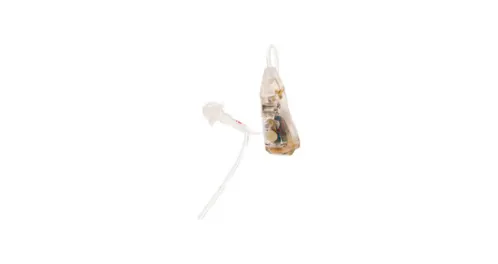





The Comfort Fit hearing aid is designed for individuals who value comfort, natural sound, and a discreet fit. It may be the right choice if you:

Find answers to common questions about payment and financing
SpeechEasy is a small and inconspicuous fluency-enhancing device for people who stutter. It is a fully portable prosthetic device that is worn in or behind one of the client's ears.
For years, it has been known that when people who stutter speak the same material in unison with another speaker, they become more fluent. This is known as the 'Choral Speech Effect'. With SpeechEasy, this effect is achieved through a combination of Delayed Auditory Feedback (DAF) and Frequency Altered Feedback (FAF). Using DAF allows the client to hear his or her own voice with a slight delay, similar to an echo. FAF allows the client to hear his or her own voice with a shift in the pitch. The combination of DAF and FAF is referred to as Altered Auditory Feedback (AAF). The brain perceives this AAF as someone different speaking along with the person who stutters therefore creating the Choral Speech Effect.
SpeechEasy comes in three shell styles. The Behind-The-Ear (BTE), In-The-Canal (ITC), Completely-in-the-Canal (CIC) and the Comfort Fit (CF). There are different advantages associated with each shell style. The client and the SpeechEasy Provider will discuss the options during the evaluation and determine which style is most appropriate. The size and shape of your ear and ear canal may also play a part in determining the best style for you.
Our trained Providers program SpeechEasy by using a computer and special programming software. DAF, FAF and volume can be programmed for each individual's needs.
Empirical data collected from thousands of clients shows that the vast majority of those who have tried the device have shown a marked improvement in their fluency level. This level of fluency improvement varies for each individual client, and depends on a number of internal and external factors.